Two: Cellular Automata and the Game of Life
In the late 70's, while I was studying at U of T, I attended a conference held on campus. It was jointly sponsored by Toronto’s Science Fiction Library (under Judith Merrill) and the Toronto Association for Buddhism. The topic of the conference was the relationship between technology and consciousness. Most of the session have faded from my own awareness, but there was one that I remember clearly and which has had a profound effect on the development of my own consciousness. Needless to say, it was actually this session that originally attracted me to the conference.
The session was conducted by Dr. Rudy Rucker, professor of Mathematics at Berkley university, one of the principal minds in the development of Chaos Theory and also a talented science fiction writer in the new genre of "cyber-punk" science fiction. I had just read one of his novels, Software, and had been intrigued by many of the ideas presented in it.
Rudy Rucker entered with several boxes on a cart which when unpacked revealed the first desktop computer I had ever seen. I was taking Computer Science at the university, but we were still using punch cards and computers the size of a bedroom. The idea that computing power could be placed into such a small unit was hear of, but this was the first I had seen of it. (The computer used by Rucker was probably less powerful than a current calculator.) On this computer Rucker proceeded to demonstrate his experiments with cellular automata. In brief, cellular automata are graphic representations of equations that change and evolve. There are many different examples, but for the sake of explanation let me explain the one example that I want to examine more closely.
Cellular Automata
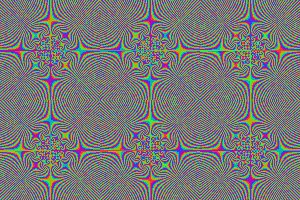
"Cellular automata are self-generating computer graphics movies." Imagine a computer screen divided into coordinate pixels. Each pixel can be on or off, and can change colour or intensity. A mathematical rule expressed as an equation determines what will happen to each cell with each progressive update of the screen. The equation contains variables into which can be placed certain parameter values or random numbers. In the game of "Life", for example: "The Life rule has two states, 0 and 1. Count how many of your nearest eight neighbors are on. If three are on, then you turn on. If two are on, then you stay in your same state. If fewer than two or more than three neighbors are on, you turn off." (Taken from the manual accompanying these programs, found on Rudy Rucker’s web site.) This is a very simple rule for relating each pixel to the eight pixels adjacent to it. The rule holds for every pixel on the screen and the image is updated every time the rule is applied. The result is a changing image. As the rule seems very arbitrary, you would not expect there to be any order or organization. You would expect the image to be like a dead TV channel. But the whole point of cellular automata is that this is, remarkably, not the case.
When you look at the Life CA, it is very clear that as the graphics develop, patterns emerge. Some of these patterns are static. Some of them are shapes that move across the screen, intersecting with other groups of cells and having an impact on them, according to the rule. It is a visual representation of order evolving out of chaos. And it is not true solely in the rule for Life, but can also be seen in all of the other rules and programs that Rucker and his associates have developed.
Causal Impact
When I first saw this on the screen it immediately struck me as a metaphor for the events of life and for causality in general. Here was a mathematical representation of order from chaos!! A possible explanation of how life can come from nothing and of how the universe is trying to make itself more complex and intelligent. Why does life evolve? Perhaps, because there is an underlying law of reality that encourages order from chaos.
Imagine the world as a three dimensional grid and the things within it as the order which is created out of disorder by chaos theory. Imagine the events that happen as the progression of this rule through a series of applications. Until the development of the computer it has not been possible for people to view reality in this manner, -as a series of rule applications. Only the ability to calculate so quickly and then representing it graphically on a screen has made it possible at all.
Rucker provided the people attending his session with a 5½" floppy disc containing the program. It was not until several years later that I was able to put it into a computer and run it. When I did, I sat and watched it for hours at a time, intrigued by the pixels coming together. The program comes with the feature of allowing you to stop it and either add or subtract a pixel on the screen. It was amazing to see how one pixel could have absolutely no effect what so ever, or, on the other hand, could alter the entire structure of the screen. One carefully placed pixel added to a static structure could cause it to disintegrate or explode across the screen. After a while I began to get a sense of where to place pixels to accomplish desired results.
Eventually, after reading Gleick’s book on Chaos Theory and playing around with his much more sophisticated program, I began to think of the reality metaphor again. Gleick speaks in his book about a butterfly flapping its wing in Japan possibly creating a tornado in Florida. In other words, a minuscule action may, under the right circumstances, have tremendous causal impact. Now, this is not true of just any action. Most of the cells added to the Life screen just wink out. But certain ones have a major effect on the configuration of the screen, not just adjacent to it, but elsewhere as well. Similarly, not just any action will have causal impact. In fact, most will not. But certain actions, whether placed accidentally or on purpose, have the ability to effect major change in a situation.
On a very physical scale, this effected my philosophy of teaching tremendously. I began to think of teaching as providing inputs at critical moments. I began designing experiences that would tweak causality. I began thinking of teaching as the art of creating the realities that would lead to the desired goals. (Not always successfully, mind you.) Tom Brown’s and John Young’s description of Coyote Teaching, practised by the Native People, discussed in a later chapter, falls precisely into that mode of teaching.
Spiritual Impact
But the more profound awareness cam when I was reading a book by Depak Chopra. In The Seven Spiritual Laws of Success, Chopra talks about meditation placing the tiny force of intention into the fabric of the universe. In fact, he talks about placing the intention in the place between thoughts. ..And then "let the universe handle the details. Your intentions and desires, when released into the gap, have infinite organizing power. Trust that infinite organizing power of intention to orchestrate al the details for you." (Chopra, Seven Spiritual Laws of Success, p. 78) So, perhaps an intention, placed between the thoughts in a meditation, has that power of causal impact, -like the butterfly wing and the tornado. Who is to say that thought and intention do not have power?
If this is the case, then we have a scientific argument for dynamic meditation. -For prayer, if you will. Wishing for something in the right way, may impact on its development. Interfacing with the laws of the universe on its terms, rather than on ours, may make the "possible" out of the "impossible".
Epilogue
After the conference, it seems that with all that consciousness floating around, no one had made any plans for Dr. Rucker. I ended up volunteering to drive him around town in my red Volkswagen bug. We had time to talk about Science Fiction Novels, and discussed his work. I never had a chance to talk about Chaos Theory, because, at that time, I was just beginning to understand it. I often whished that I had taken the opportunity then.
Last year I went to see the movie, Run Lola Run. As I was watching it, I was amazed at how it fit in with my thoughts regarding cellular automata and causality. In the movie Lola has to deliver money to her boyfriend or he will be killed. The movie shows the same 30 minutes of activity several times over, repeating it with very minor changes and showing how these changes can alter the outcome. Not only does it change the outcome of her goals, but also those of the people she encounters.
I was so inspired by the film that I tried to e-mail Rudy Rucker through his web site. To my surprise, he responded quite quickly and said that he, too, had seen the movie and that he could easily see my point.
I think that there are all kinds of links between chaos theory and a new view of reality. In her book, The Tao of Chaos, Katya Walter explores the relationship between Chaos Theory, genetic coding and the I Ching. When you think about it, all are based on randomness, and it is possible that they all could be subject to the same forces of organization. In The Holographic Universe, Michael Talbot goes a step further to try to explain many metaphysical phenomena in terms of this quantum reality.